
What Is TensorFlow? How It Works and Why It Matters to AI
A plain-English guide to TensorFlow: what tensors and computational graphs are, how models are trained and deployed, a short Keras example, TensorFlow Lite, TensorFlow vs PyTorch, and why this framework matters to modern AI.
AI Basics — a 3-part series
You're on part 2 of 3. Read the whole path from the ground up.
- 1What Is AI? Machine Learning and LLMs Explained
- 2What Is TensorFlow? How It Works and Why It Matters to AI · You are here
- 3TensorFlow vs PyTorch: Which Should You Learn?
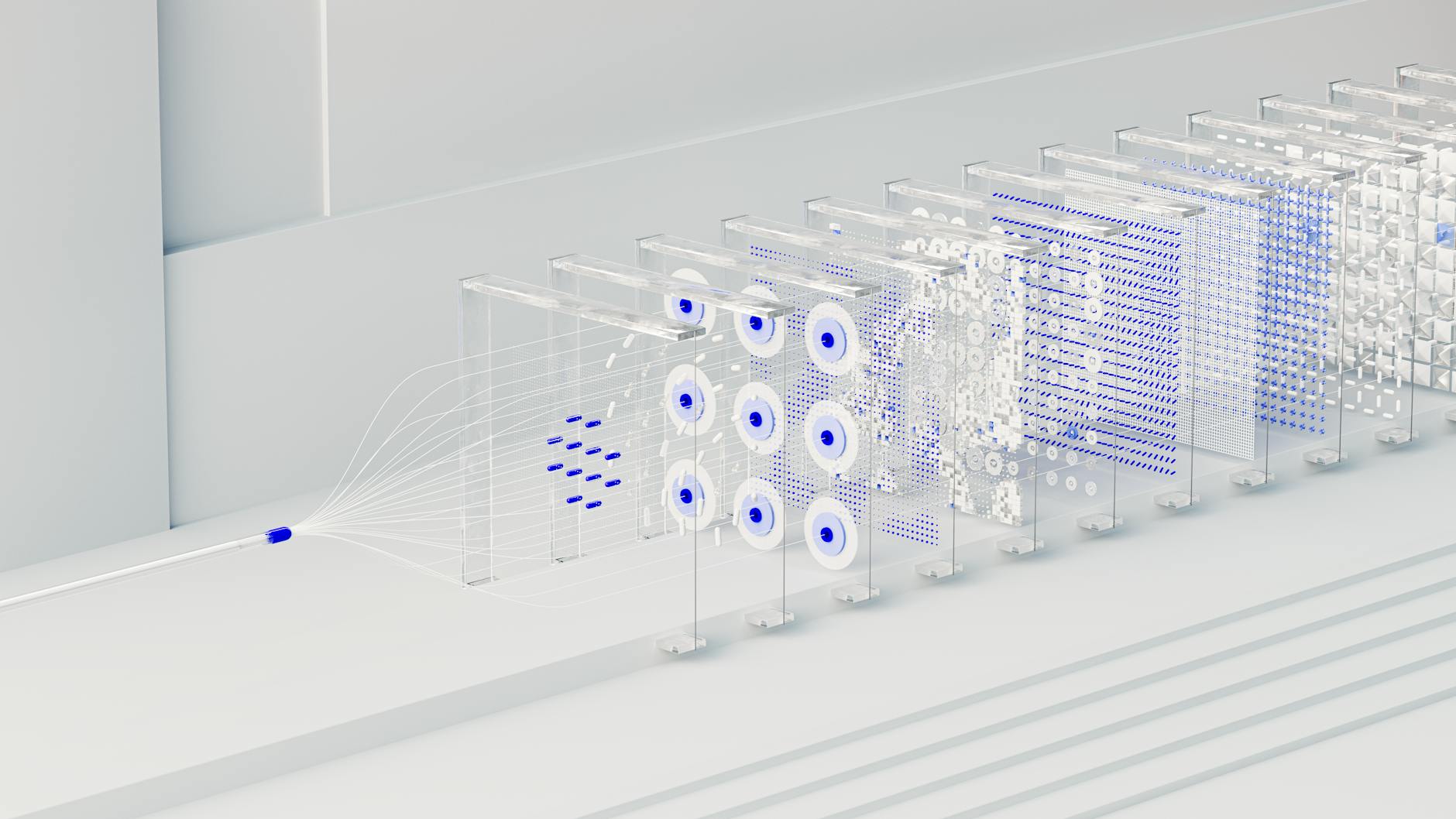
If the last post answered what AI is, this one answers what we build it with. TensorFlow is one of the most widely used tools on the planet for creating machine-learning models — the software that powers everything from Google Photos search to on-device voice assistants. This is a plain-English tour of what TensorFlow is, how it actually works under the hood, and why it matters to modern AI.
What is TensorFlow?
TensorFlow is a free, open-source machine-learning framework originally developed by the Google Brain team and released to the public in 2015. A "framework" here just means a toolbox: instead of writing the low-level math for neural networks by hand, you use TensorFlow's ready-made building blocks to define, train, and deploy models.
The name is a clue to how it works:
- Tensor — a multi-dimensional array of numbers. A single number is a 0-D tensor, a list is 1-D, a table is 2-D, an image is 3-D (height × width × color), and a batch of images is 4-D. Essentially all data — text, images, audio — gets turned into tensors.
- Flow — the tensors flow through a graph of mathematical operations. TensorFlow builds a computational graph where data moves from one operation to the next, transforming as it goes.
So "TensorFlow" literally describes tensors flowing through a network of computations. That's the whole idea in two words.
How TensorFlow works
At a high level, using TensorFlow follows a simple loop that mirrors how machine learning itself works:
1. Represent data as tensors
Your dataset — say, 60,000 handwritten-digit images — is loaded and converted into tensors of numbers that the model can process.
2. Build a model (the graph)
You stack layers of operations. Each layer has adjustable numbers called weights. Early layers detect simple patterns (edges, curves); later layers combine them into complex concepts (a "7", a cat, a spoken word).
3. Define a loss and an optimizer
The loss function measures how wrong the model's predictions are. The optimizer (usually a variant of gradient descent) nudges every weight slightly in the direction that reduces that error.
4. Train
TensorFlow runs the data through the graph, measures the loss, and uses automatic differentiation (its GradientTape) to calculate exactly how to adjust each weight. Repeat this millions of times and the model gradually gets good at the task.
5. Deploy
Once trained, the model is saved and served — in a data center, a website, a phone, or even a microcontroller.
The magic ingredient is hardware acceleration. TensorFlow automatically runs those tensor operations on GPUs and Google's custom TPUs (Tensor Processing Units), turning computations that would take weeks on a CPU into hours.
A tiny example with Keras
Modern TensorFlow ships with Keras, a high-level API that makes building models remarkably readable. Here's a complete image classifier in just a few lines:
import tensorflow as tf

# Load and normalize the MNIST handwritten-digit dataset
(x_train, y_train), (x_test, y_test) = tf.keras.datasets.mnist.load_data()
x_train, x_test = x_train / 255.0, x_test / 255.0

# Build the model
model = tf.keras.Sequential([
    tf.keras.layers.Flatten(input_shape=(28, 28)),
    tf.keras.layers.Dense(128, activation="relu"),
    tf.keras.layers.Dropout(0.2),
    tf.keras.layers.Dense(10, activation="softmax"),
])

# Train it
model.compile(optimizer="adam",
              loss="sparse_categorical_crossentropy",
              metrics=["accuracy"])
model.fit(x_train, y_train, epochs=5)
model.evaluate(x_test, y_test)
That's it — a working neural network that recognizes handwritten digits with ~98% accuracy. Keras hides the plumbing so you can focus on the ideas.
Real-world uses
TensorFlow runs in production at massive scale. Some familiar examples:
- Image recognition — photo tagging, medical imaging, quality inspection on factory lines.
- Natural language — translation, sentiment analysis, and the foundations of chatbots.
- Recommendation systems — the "you might also like" suggestions on shopping and streaming sites.
- Speech — voice assistants turning audio into text and back.
- Time-series & anomaly detection — forecasting demand or spotting fraud and network intrusions.
TensorFlow on the edge: TensorFlow Lite
Not every model runs in the cloud. TensorFlow Lite (LiteRT) shrinks trained models so they run directly on phones, Raspberry Pis, and even tiny microcontrollers — no internet required. This is how your phone can unlock with your face, filter spam, or transcribe speech offline, keeping data private and responses instant. For the browser, TensorFlow.js runs models directly in JavaScript.
TensorFlow vs PyTorch
You'll often hear TensorFlow mentioned alongside PyTorch (from Meta), its main rival. A fair, honest comparison:
- PyTorch is loved in research for its intuitive, Pythonic feel and dominates academic papers.
- TensorFlow has historically had the edge in production deployment — its serving tools, mobile/edge support (TF Lite), and browser support (TF.js) make it easy to ship models to real users and devices.
The two have converged a lot: modern TensorFlow (with Keras) is just as approachable as PyTorch. The best choice usually depends on your team and where the model needs to run — there's no wrong answer, and skills transfer between them.
Why TensorFlow matters to AI
TensorFlow's real contribution is democratization. Before frameworks like it, building a neural network meant hand-coding complex calculus and managing GPU memory yourself. TensorFlow abstracted that away and made it free and open source, so a student on a laptop and an engineer at a global company use the same tools.
That matters for three reasons:
- Speed of progress — researchers can test ideas in hours instead of weeks, accelerating the whole field.
- Accessibility — you don't need a PhD in numerical computing to train a useful model.
- From lab to real life — its deployment tooling means models don't just work in a notebook; they ship to phones, browsers, and servers where they actually help people.
The bottom line
TensorFlow is the workbench of modern machine learning: it turns data into tensors, flows them through a graph of operations, and uses hardware acceleration to train models efficiently — then helps you deploy them anywhere, from a data center to a wristwatch. It didn't invent AI, but by making the tools free, fast, and approachable, it helped put AI in the hands of everyone. Whether you eventually reach for TensorFlow or PyTorch, understanding how a framework like this works is the difference between treating AI as magic and being able to build with it yourself.
TensorFlow vs PyTorch: Which Should You Learn?
View in portfolioNext in the AI Basics series · Part 3
TensorFlow vs PyTorch: Which Should You Learn?
More in Artificial Intelligence
You might also like
Never miss a post
Get new cybersecurity and networking write-ups straight to your inbox. No spam — unsubscribe anytime.